- Category: Library
- 2026-03-20
The ENTSO-E, representing 40 electricity transmission system operators (TSOs) across 36 countries, plays a central role in ensuring the secure and coordinated functioning of Europe’s power grid, the largest interconnected electricity system in the world. As Europe faces rising technical complexity, cross-border interdependencies, and growing cyber and physical threats, ENTSO-E is calling for a stronger integration between energy and space policy.
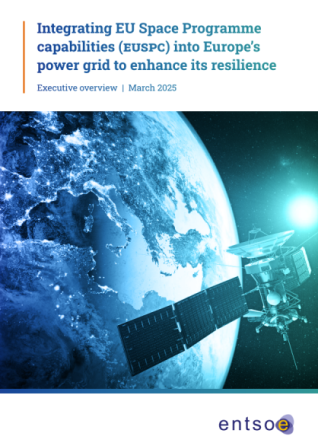
In its recent feedback to the European Commission on the proposed EU Space Act, ENTSO-E emphasizes that TSOs should be formally recognised as critical users of EU space services. This recognition reflects the increasing reliance of electricity system operations on capabilities such as real-time situational awareness, secure communications, and precise timing, all areas where space-based technologies can play a decisive role.
The feedback outlines how services from the EU Space Programme can complement terrestrial infrastructure. Rather than replacing existing systems, ENTSO-E promotes a hybrid approach in which space-based tools act as an additional layer to enhance resilience and reliability. This is particularly relevant in a context where uninterrupted electricity supply depends on accurate grid synchronisation, rapid response to disruptions, and robust cross-border coordination.
Key EU space assets (including Copernicus for environmental monitoring, Galileo Public Regulated Service for secure positioning and timing, and GOVSATCOM) offer mature, secure, and EU-owned solutions tailored for public authorities. Future initiatives such as IRIS² will further strengthen these capabilities. However, their integration into electricity transmission operations remains limited, which is a gap ENTSO-E aims to address.
The document identifies several operational domains where space services can deliver immediate value. These include enhanced monitoring of infrastructure and environmental risks, resilient timing systems critical for grid stability, secure communications during emergencies, and early warning systems for high-impact risks such as space weather events. Importantly, these applications are designed to reinforce existing systems without creating new dependencies.
ENTSO-E also stresses alignment with existing EU legislation, notably the Critical Entities Resilience Directive and the NIS2 Directive, ensuring that the proposed approach supports compliance without adding regulatory burden.
Ultimately, this initiative positions TSOs not just as users of space data, but as active partners in shaping future space services. By anchoring EU space policy in the operational realities of electricity transmission, ENTSO-E contributes to a more resilient, secure, and strategically autonomous Europe, both in energy and in space.
To read the full paper, click here